
APMM Engagement in the 2026 Asia Pacific Peoples’ Forum Preparatory Session
The Asia Pacific Regional CSOs Engagement Mechanism (APRCEM) organized a learning session on 12 February 2026, to unpack the ongoing challenges and systemic barriers to achieving genuine sustainable development. The session also highlighted Development Justice as an alternative to the dominant neoliberal development model. This discussion formed part of the lead-up to the Asia Pacific Peoples’ Forum on Sustainable Development (APPFSD) on 22–23 February 2026 and the 13th Asia Pacific Forum on Sustainable Development (APFSD) on 24–27 February 2026.
Represented by Dewi Amelia, APMM was honored to share grassroots migrants perspectives on how intersecting crises are affecting communities across Asia and the Pacific, and how Development Justice is being advanced through migrant organizing, campaigns and advocacy.
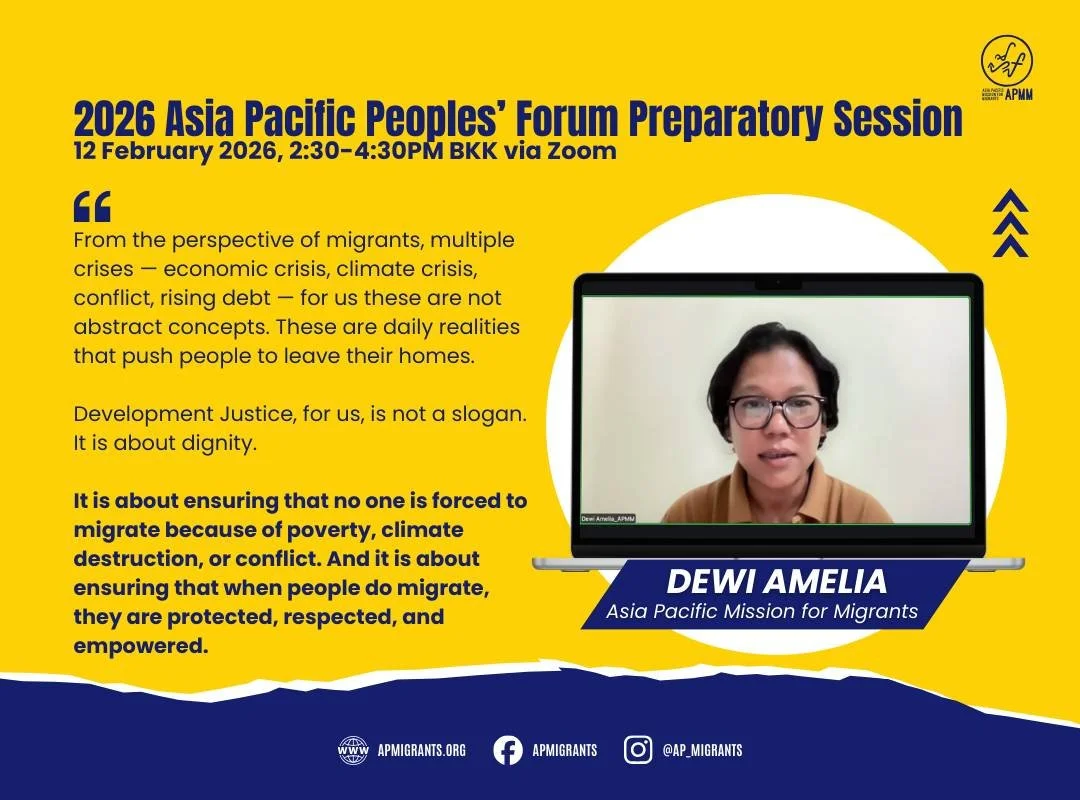
Below is her presentation from the session:
Thank you, and greetings to everyone. Thank you for the opportunity to be part of this important discussion.
From the perspective of migrants, multiple crises - economic crisis, climate crisis, conflict, rising debt - for us these are not abstract concepts. These are daily realities that push people to leave their homes.
In many of our countries, there are simply not enough decent jobs. Prices of food, fuel, and basic goods continue to rise. Wages do not keep up. Public services are cut because governments say there is no budget. Farmers lose land. Fishers lose access to the sea. Young people graduate but cannot find stable work.
So families make painful decisions. A mother leaves her children. A father misses birthdays and funerals. A daughter migrates before she turns twenty. Migration is presented as an opportunity, but for many of us, it is a survival strategy.
But when migrant workers arrive in destination countries, the crisis does not end.
We face high recruitment fees that trap us in debt before we even begin working. We experience contract substitution, low wage, long working hours, and unsafe conditions. Domestic workers face isolation inside private homes, where abuse often goes unseen. Undocumented workers live in fear of detention and deportation. Many migrants are excluded from social protection, health care, and legal remedies.
Women migrant workers carry a double burden. They are expected to provide care work abroad while also remaining emotionally responsible for families left behind. Yet their labor remains undervalued and invisible.
The climate crisis is also pushing more communities into migration. Typhoons destroy homes. Floods wipe out crops. Droughts eliminate livelihoods. When land and income disappear, people move - first internally, then across borders. But climate-displaced migrants have no clear legal protection.
At the same time, we see growing militarization and shrinking civic space. Community organizers are harassed. Migrant leaders are red-tagged. Workers who speak up risk losing their jobs or visas. The very people most affected by these crises are often silenced.
From our grassroots perspective, these crises are connected. They are linked to a development model that prioritizes profit over people, debt payments over public services, and militarization over social protection.
The pillars of Development Justice already reflect many of the demands and aspirations of migrants - from economic and social justice to accountability. However it will be worthwhile to revisit and see how the emerging issues and challenges such as digitalisation and technological governance be considered or be a new point of discussion, to ensure they continue to respond to the evolving realities faced by migrant communities.
So how do we practice Development Justice?
First, we organize.
Migrant workers form associations, unions, and support groups. We create safe spaces where workers can share experiences, learn about their rights, and support one another. We conduct political education so migrants understand that their struggles are not individual failures, but part of a larger system.
Second, we assert that migration must be a choice, not a necessity.
Development Justice means creating decent jobs at home, investing in agriculture and local industries, ensuring living wages, and providing social protection so that people are not forced to leave just to survive.
Third, we demand rights and protection wherever we are.
We call for accountable recruitment fees, living wages, access to justice, social protection, and full recognition of domestic work as work. We push for regularization pathways for undocumented migrants and protection mechanisms that are accessible and effective.
Fourth, we build solidarity across borders.
Grassroots organizations in origin and destination countries connect with one another. When a worker is abused, we mobilize. When policies harm migrants, we speak collectively. We challenge xenophobia and discrimination by showing that migrants are workers, community members, and rights holders.
Development Justice, for us, is not a slogan. It is about dignity.
It is about ensuring that no one is forced to migrate because of poverty, climate destruction, or conflict. And it is about ensuring that when people do migrate, they are protected, respected, and empowered.
The voices of migrants must not be treated as side notes in policy discussions. Migrant engagement in advocacy spaces remains highly restrictive and minimal. While policies about us are discussed at national, regional, and global levels, migrants themselves are often excluded from meaningful participation. Most migrant engagement, as many other grassroots, continues to happen on the ground — within our own communities and directly with our home and host governments. Grassroots organizing remains our primary space for action, because formal platforms still limit our access, voice, and decision-making power.
Platforms like APRCEM are important because they champion grassroots voices, including migrants, and create space for our direct engagement in regional processes.
Any meaningful response to today’s crises must center migrant leadership and grassroots solutions.
Thank you.
