
Advocating Transformative Action Toward MDWs’ Right to Development: APMM’s Virtual Side Event During the 13th APFSD
On February 26, Asia Pacific Mission for Migrants, together with the Network for the Protection of Women Migrants Rights (NPWMR), Asia Pacific Alliance for Sexual and Reproductive Health and Rights (APA), Jaringan Buruh Migran Indonesia (JBMI), and Mission for Migrant Workers (MFMW), held a virtual side event at the 13th Asia Pacific Forum on Sustainable Development. Entitled, “Advocating Transformative Action Toward Migrant Domestic Workers (MDWs) Right to Development,” the event examined systemic barriers preventing migrant domestic workers (MDWs) from fully realizing their development rights.
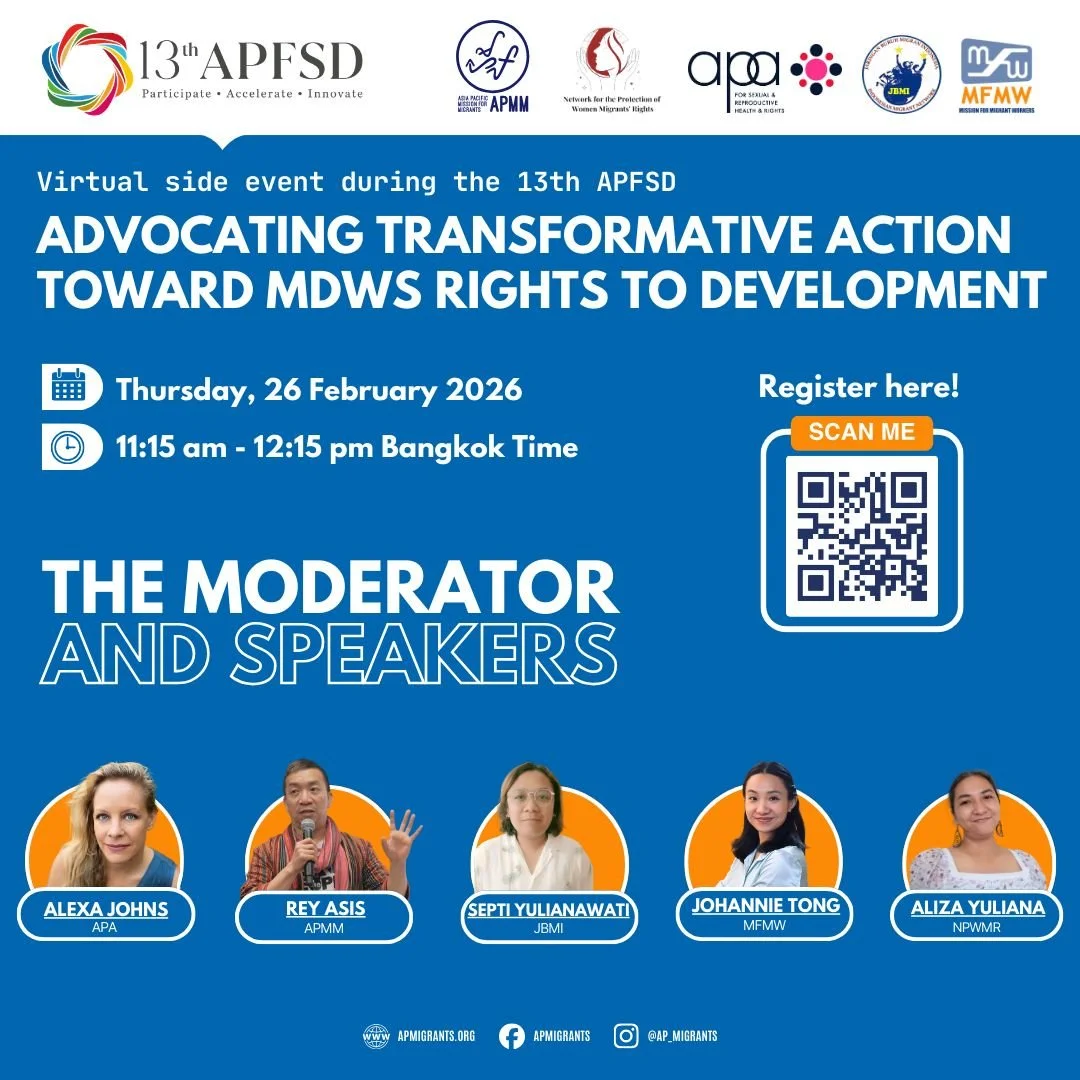
Structured as a talk show, the discussion situated the experiences of migrant domestic workers within the discourse of the Sustainable Development Goals (SDGs), particularly SDG 11 (Sustainable Cities and Communities) and SDG 17 (Partnerships for the Goals). Despite commitments to inclusive urban development, MDWs continue to experience inequality, discrimination, and exclusion from development processes.
In his opening remarks, Rey Asis of APMM explored the urgent issues affecting MDWs in the region. He analyzed the shrinking civic and political spaces available to migrants, which limit their meaningful participation in policy discussions that shape their lives. Rey also critiqued diaspora investment models and emphasized the importance of amplifying migrant voices. Rey finally called on the institutionalization of pathways that enable MDWs’ meaningful engagement at the local, national, and regional level.
“We are actually having this side event because we really want to amplify the voices of migrant domestic workers, women migrant domestic workers across the region, in terms of their current situation, and what are their demands, and how can we really work together in realizing the participation and the engagement, the intentional and meaningful and effective engagement and participation of migrant domestic workers in all spaces, may it be at the national level, at the regional level, or even at the global level”
- Rey Asis, Asia Pacific Mission for Migrants
The talk show was hosted by Alexa Johns of APA and featured three speakers: Jepy of JBMI, Johannie Tong of MFMW, and Aliza Yuliana of NPWMR. Over 70 participants across the Asia-Pacific region attended the event.
Jepy from JBMI shared about the barriers Indonesian MDWs face in cities, such as low wages, tied visas, and exclusion from public services. She emphasized how, despite significant economic contributions to urban development, MDWs are treated as second-class citizens and are denied full enjoyment of their development rights.
“..., migrant domestic workers can’t enjoy the right to development, particularly to sustainable city and community, prohibited by the migration system that puts migrants as second class workers. Forced migration has increased our vulnerability and lowered our bargaining power and situated us to accept and adapt to harsh situations that we face”
- Jepy, Jaringan Buruh Migran Indonesia
She advocated for humane migration systems, direct hiring mechanisms, living wages, and formal recognition of MDWs as legitimate workers under labor law frameworks. Importantly, she underscored the need to operationalize the SDG principle of “Leaving No One Behind,” not as rhetoric but as an enforceable policy.
Building on this analysis, Johannie Tong of MFMW discussed the compounded vulnerabilities of MDWs during crises and disasters. She raised recurring challenges such as scams, delayed assistance, and psychological trauma. Due to their migration status, MDWs experience limited access to services and relocation support. Migrants also experience barriers to timely and understandable information to overcome language gaps.
“In short, for migrant domestic workers in crisis, no matter if it's during the COVID-19 pandemic, or this time in the crisis of fire, they become invisible and indispensable workers. Their vulnerability is rooted in their migration status, actually, and their employment conditions as well. This leads to the problems in housing, neighbor, and living conditions, issues that demand urgent reform of humane housing, clear protections, and accessible healthcare, and equitable access to justice as well”
- Johannie, Mission for Migrant Workers
Johannie called on governments to provide multilingual emergency information, accessible relocation assistance, and free health and mental health services tailored to the needs of migrant communities.
Aliza Yuliana of NPWMR argued that migrant women must lead advocacy and decision-making processes directly to address the root causes of their exploitation. She argued that transformative change requires confronting the gendered and structural roots of exploitation embedded within the migration process.
“..., we work together with community or grassroots migrants and bring forward the reality from the ground for solutions to address the root cause, not just the issue”
- Aliza Yuliana, Network for the Protection of Women Migrants Rights
Aliza emphasized that the meaningful participation of migrant women in transnational networks and policy platforms is essential to achieving substantive reforms. Their leadership in these processes ensures that policies are grounded in their own lived experiences.
After speakers shared their experiences and recommendations, participants shared positive practices in their advocacies and campaigns. There was a lively sharing on providing services in communities, providing access to information, implementing rights and welfare programs, and organizing MDWs into collectives to demand real changes.
Overall, the online talk show ended with a strong reaffirmation. Sustainable cities cannot be realized while migrant domestic workers remain excluded from development. Collaboration among civil society, governments, and especially with grassroots migrant organizations is essential in dismantling discriminatory systems and building inclusive frameworks.
