
Asia Pacific Conference of Migrant Service Providers 2026: Empowerment beyond and through services
Asia Pacific Mission for Migrants (APMM) together with the Mission for Migrant Workers, the Department of English and Communication of the Hong Kong Polytechnic University, Migration and Communication Hub, the Asia Pacific Interfaith Network for the Rights of Migrants (AP INFORM) and Microlab has successfully convened the Asia Pacific Conference of Migrant Service Providers on January 16-18, 2026 at the Hong Kong Polytechnic University, Hong Kong SAR, China.
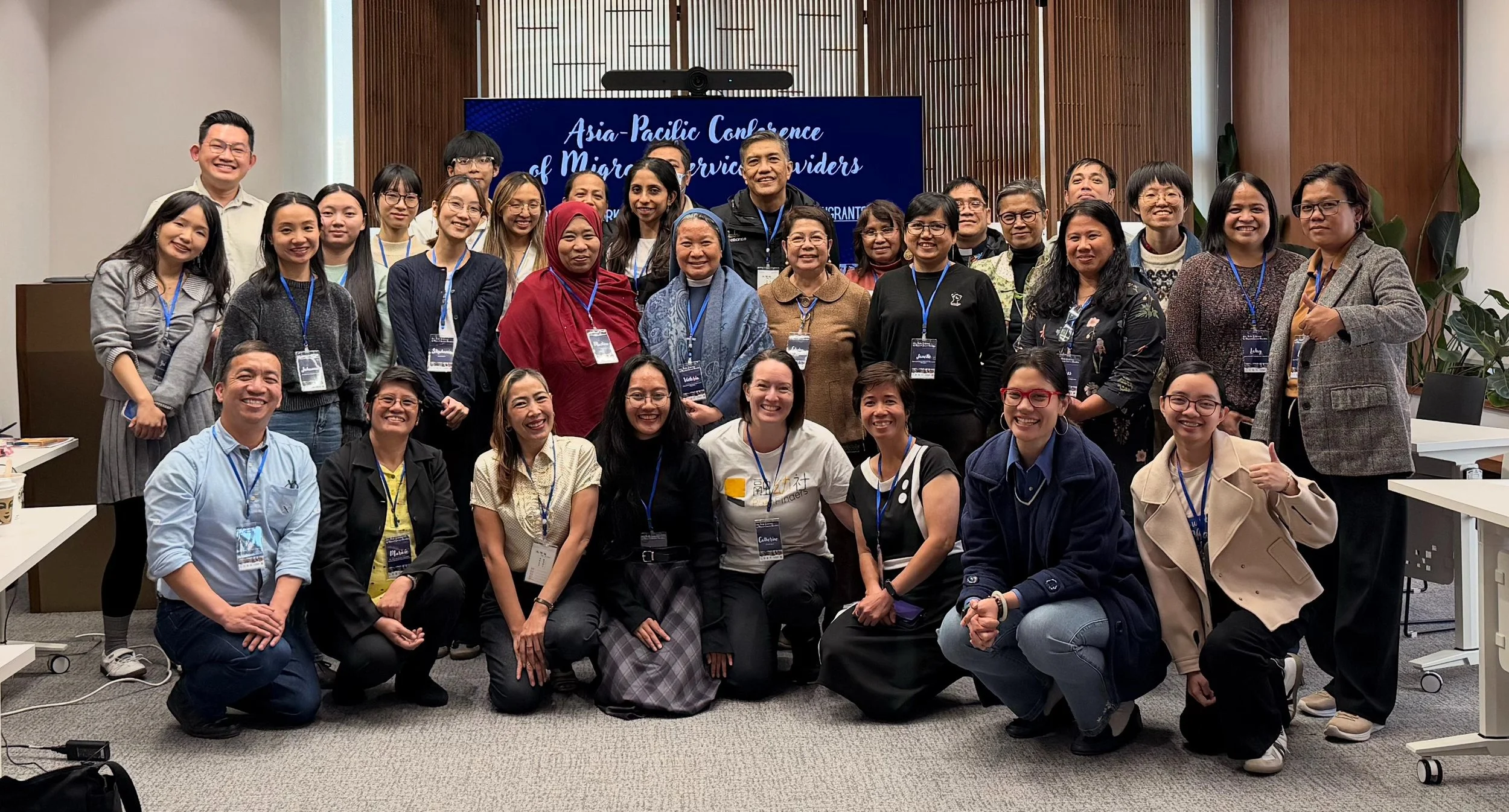
Carried by the theme “Sharing and Working Together to Serve and Empower Migrants,” the conference brought together 38 migrant service providers from Australia, Indonesia, Japan, Malaysia, New Zealand, Philippines, Singapore, South Korea, Taiwan, Middle East and Hong Kong. Participants represented a diverse range of church-based, Islamic, civil society, academic, and grassroots migrant organizations.
Setting the political tone, APMM General Manager Aaron Ceradoy emphasized that migrant advocacy must go beyond service provision. Protection, he argued, is incomplete without empowerment—enabling migrants to organize, speak for themselves, and assert their rights.
In his welcoming remarks, Prof. Eric Friginal, Head of the Department of English and Communication of The Hong Kong Polytechnic University, highlighted the importance of creating spaces where migrant voices, experiences, and even joys can be shared and learned from.
A faith-based reflection was delivered by The Rt. Revd Andrew Chan, Archbishop and Primate of Hong Kong Sheng Kung Hui (HKSH), who grounded migrant service in the moral imperative to recognize dignity, restore agency, and build life-giving communities.
The keynote on strengthening cooperation between service providers and migrant communities was delivered by Shiela Tebia of the Asian Migrants Coordinating Body (AMCB). Speaking from her lived experiences, she traced her journey from witnessing abuse as a migrant’s child, to surviving violence herself, and ultimately becoming an organizer. Her testimony illustrated the critical partnership between service providers, who offer crisis response and institutional access, and migrant-led organizations, which build collective power and sustain long-term advocacy.
The opening session was followed by multiple panel discussions which focused on different aspects of services given to migrants.
Services as commitment to the people
Resource speakers in Panel 1 focused on their experience and good practices in attending to the needs of distressed migrants through assistance. They emphasized the paradox at the core of contemporary labor migration - migrant workers are indispensable to national economies, yet they are systematically denied protection. Jaya Anil Kumar of HOME (Singapore) underscored this contradiction, noting that sectors from construction to services depend on migrant labor. Similar to the Singapore case, Johanie Tong of Mission for Migrant Workers also described how domestic workers in Hong Kong remain excluded from minimum wage protections and constrained by immigration rules that discourage complaints.
Contributions from Australia and faith-based organizations reinforced these observations. Ness Gavanzo of Welfare Mission for Migrants (WMM) characterized temporary migrants as “over-regulated but exploited.” Meanwhile, Sr. Victoria Victorino of Diocesan Pastoral Centre for Migrants (DPCM) highlighted accompaniment, counseling, and community as essential responses, arguing that collective care counters the isolation produced by precarious work and migration status.
Building on these insights, Panel 2 shifted service provision in terms of addressing women migrants’ needs and the importance of a migrant shelter. Edwina Antonio of Bethune House described the realities faced by migrant shelters who struggle from overcapacity, and limited resources. She emphasized a need for a holistic approach that addresses migrants’ physical, emotional, and psychological well-being. Pastor Galang of KASAMMAKO (South Korea) shared how organizing itself becomes a form of protection, noting that when migrant workers establish strong communities, mutual support happens amidst government negligence.
Stephanie Kwok of Pathfinders discussed crisis intervention paired with leadership development, training migrant domestic workers to become community advocates for maternity and reproductive rights. Meanwhile, Yicai Hsiao of the Serve the People Association in Taiwan highlighted the severe risks faced by undocumented migrant mothers, who are pushed into unsafe childcare arrangements due to inaccessible legal services—sometimes with fatal consequences.
Panel 3 further deepened the discussion on how information dissemination, education and capacity development, research and advocacy engagement contribute to the protection of rights and wellbeing of migrants. Amie Maga of Migrant Action Trust emphasized that helping migrants secure employment is insufficient without equipping them with knowledge of their rights. Jeffry Oktavianus, a professor at the Department of English and Communication at the Hong Kong Polytechnic University, added that many migrants, particularly from Indonesia, are conditioned by recruitment agencies to endure abuse to complete their contracts. This demonstrates the structural constraints that shape and limit migrant choices. Marissa Medina Gargarita of St. John Neumann Migrant Center in the Philippines broadened the lens to include families left behind, stressing the importance of community support systems in mitigating the emotional and social impacts of long-term labor migration. Umi Kalsum of Beranda Migrant shared their views on how migration is a structural problem rooted in poverty, economic control by the private sector, and government reliance on remittances as a long-term economic solution.
The last panel delved into the many challenges faced by migrants, such as cybertrafficking, third-country recruitment, and anti-migrant policies. A delegate from Migrante Middle East shared how the Kafala System becomes a mechanism that legally binds migrants’ residency and mobility to their employers, sustaining power imbalances despite announced reforms. Rey Asis of Asia Pacific Mission for Migrants connected these regional realities to global political economic structures. He argued that the prevailing system continues to commodify migrant labor and intensify forced migration amid economic, political, and environmental crises.
Following the panels, participants engaged in workshops to identify shared gaps, challenges, and concrete pathways for cooperation. Across groups, common concerns emerged: repressive and deceptive migration policies, shrinking civic spaces, funding and staffing constraints, gender-based violence, legal and documentation barriers, and the need to care for the service providers themselves.
Discussing next steps to build cooperation and solidarity, the participants agreed to working together and realising next steps to better servicing migrants and supporting their empowerment.
